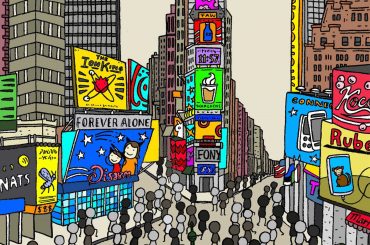
This excerpt from Terence McKenna’s “Dreaming Awake at the End of Time” (December 13, 1998) explores how personal agency and intentional meaning-making can free us from the gravitational pull of inherited cultural stories.
Balkanization of epistemology is taking place. And what I mean by that is there is no longer a commonality of understanding. I mean, for some people, quantum physics provides the answers.
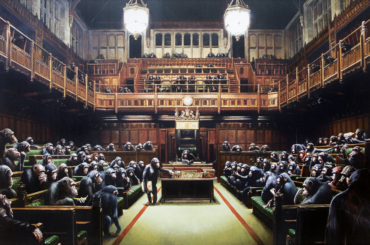
Their next-door neighbour may look to the channeling of archangels with equal fervor. I mean, if this is not a Balkanization of epistemology, I don’t know what it is. It is accompanied by a related phenomenon, which is technology or the historical momentum of things is creating such a bewildering social milieu that the monkey mind cannot find a simple story, a simple creation myth or redemption myth to lay over the crazy contradictory patchwork of profane techno consumerist, post- McLuhanist, electronic, pre-apocalyptic existence.
And so into that dimension of anxiety created by this inability to parse reality, rushes a bewildering variety of squirrely notions. Epistemological cartoons, if you will, and conspiracy theory, in my humble opinion, I’m somewhat immune to paranoia. So those of you who aren’t, you know, gaze in wonder.
Conspiracy theory is a kind of epistemological cartoon about reality. I mean, isn’t it so simple to believe that things are run by the greys and that all we have to do is trade sufficient fetal tissue to them and we can solve our technological problems? Or isn’t it comforting to believe that the Jews are behind everything or the Communist Party or the Catholic Church or the Masons?
Well, these are epistemological cartoons. It’s, you know, kindergarten stuff in the art of amateur historiography. I believe that the truth of the matter is far more terrifying.
That the real truth that dare not speak itself is that no one is in control. Absolutely no one. You know, you don’t understand Monica, you don’t understand Netanyahu.
It’s because nobody is in control. This stuff is ruled by the equations of dynamics and chaos. Now, there may be entities seeking control, the World Bank, the Communist Party, the rich, the somebody others, but to seek control is to take enormous aggravation upon yourself.
Because this process that is underway will take the control freak by the short and curly and throw them against the wall. It’s like trying to control a dream, you see. The global destiny of the species is somehow unfolding with the logic of a dream.
Well, now Jungian would say, no surprise here, history is the collective dream of humanity. It is run by archetypal energies. It is downloaded by the zeitgeist into the various milieus and epochs of which it is composed.
This seems reasonable to me. I don’t want to give you the impression. It’s too linear to understand that what I am saying is that awake is good, asleep is bad.
What I would rather do is explain this whole gradient of possible positioning vis-a-vis your life and your destiny, these choices that you have, and then have people understand that they choose, you choose to be asleep or partially asleep or fully awake or to be one part of the time and in some situations and one part of the time and in other situations. Now, if in fact we exist inside some kind of morphogenetic field that is created by the sum total of human minds on the planet and if in fact in half or more of those minds at any given moment the rules of the dream hold sway, then it is no surprise that when we make our way into society or just when we live our lives, there’s an eeriness to it. There’s a fatedness to it.
There’s a plottedness to it. We are inside some kind of engine of narrative, I believe. Some science fiction writers such as Greg Egan and others have suggested that this could even be form of recorded medium.
You can see the thumbprints of editors on our reality if you are truly paying attention. If you’re a devotee of the theory of stochastic and random unfolding of events, then you have to look very carefully at how unrandom and how mythical and archetypal most people’s lives are. If you take psychedelics and hurl yourself to the edge and spend time with strange, aboriginal people in remote parts of the world, the cosmic giggle becomes your friend.
But in fact, ordinary people’s lives, everyone’s lives, are touched by deep magic. And I’ve, you know, again, the primary datum is experience and then the models are built backward from the primary data without prejudice and in an attempt to transcend historical momentum. And when I do that, what I see is that the carrier of the field of the cosmic giggle in most people’s lives is love.
Love is some kind of output which messes with the entropic tendency toward probabilistic behavior in nature. What do I mean by that? I mean, you can be the janitor at Microsoft and the chief, the vice president in chief of operations, his daughter can bring him lunch one day and you can from a distance have your eye fall upon her and fall in love with her.
And, you know, from that point to having the five children she bears you go off to Harvard and the sore bone, it’s just a matter of running the clock forward. I mean, these things have, I mean, to you it may seem like a miracle, but to those of us who are students of human happenstance, it’s inevitable. I mean, you can launch your story.
And I’ve, you know, in the course of taking psychedelics and looking at my life and other people’s lives and narrative, I think that the secret of, I don’t want to say anything as pretentious as transcendence or enlightenment, but the secret of taking hold of one’s destiny is to understand that one is a character. A character is a different thing than this model you inherit out of the idea that you’re a three-dimensional animal inside a democracy with a Christian heritage and, you know, a Dewey decimal cataloging system or whatever.
Source: – Terence McKenna – Dreaming Awake at the End of Time